
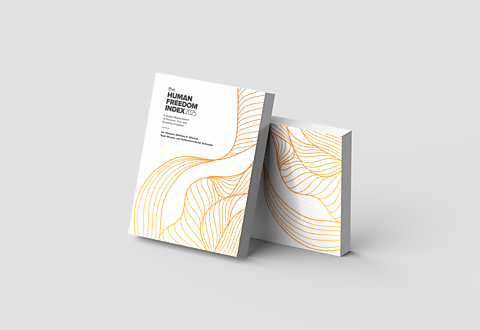

Four years after the outbreak of the COVID-19 pandemic, the level of human freedom in the world has remained depressed, according to the Human Freedom Index 2025, published today by the Cato Institute and the Fraser Institute in Canada. The report uses 87 distinct indicators of personal, civil, and economic liberty to measure the level of freedom in 165 jurisdictions through 2023, the most recent year for which comprehensive data is available.
The report finds that global freedom, measured on a population-weighted basis, reached a high point in the years 2005–2007. That was followed by a steady decline in the aftermath of the global financial crisis and coincided with the rise of various forms of illiberalism. The level of freedom collapsed in 2020 as countries responded to the pandemic and remained far below its pre-pandemic levels.
The world trend reflects a growing gap in the global inequality of freedom. Freer countries began recovering their freedom in 2021, though they have not yet reached pre-pandemic levels of freedom, whereas the least-free countries have continued to decline. The graph above divides the index by freedom quartiles to show those trends. Not only is the gap between the most and the least free growing, the distribution of freedom in the world is also highly unequal in terms of population. Only 14 percent of the world’s population lives in the freest quartile of countries in the index, while 39 percent lives in the least-free quartile.
The freest countries in this year’s index are Switzerland, Denmark, New Zealand, Ireland, and Luxembourg. The least-free countries are Myanmar, Sudan, Yemen, Iran, and Syria. The United States, which ranked 8th in 2000, ranks 15th in the current index. Other countries rank as follow: Taiwan (14th), Japan and the United Kingdom (19th), France (33rd), Brazil (66th), South Africa (71st), Mexico (91st), India (110th), Saudi Arabia (148th), China (149th), and Russia (152th).
The report’s wealth of freedom data can also help us better understand political and international developments around the world. The chart above, for example, shows Venezuela’s dramatic descent into tyranny during more than two decades of socialist rule, first under Hugo Chavez and subsequently under Nicolas Maduro. That absence of freedom explains the country’s economic, political, and humanitarian crisis and the popularity and legitimacy of opposition leader Maria Corina Machado, this year’s winner of the Nobel Peace Prize.
Likewise, after Nicaragua and Turkey, Hong Kong is the jurisdiction that saw the greatest fall in freedom in the index since the global high point of 2007. The territory used to be among the freest places in the world but now ranks 53rd. Although it has still maintained a high level of economic freedom, other areas, such as the rule of law and freedom of expression, have seen marked declines. In terms of freedom of association and assembly, for example, Hong Kong ranked 77th in 2000 when many countries scored well in that area, but it has fallen to 143rd. Because association and assembly is the area of freedom that has fallen the most globally after freedom of expression since the year 2000, Hong Kong’s decline in that indicator is especially notable. The conviction of entrepreneur and freedom champion Jimmy Lai in a sham Hong Kong trial yesterday illustrates the city’s loss of freedom, and it is difficult to imagine that Hong Kong’s economic freedoms will not deteriorate in the future.
My coauthors—Matthew Mitchell, Ryan Murphy, and Guillermina Sutter Schneider—and I also find a strong relationship between freedom and a wide array of indicators of well-being, including life expectancy, social tolerance, environmental performance, charitable giving, innovation, lower corruption, and more.
For those and many other findings, see the full report here.