

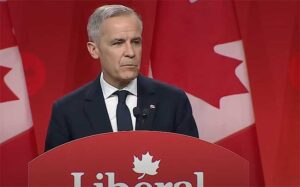
Canada is actively reshaping its global trade and investment strategy in response to continued US trade tariffs, with investors and policymakers increasingly turning their attention towards Europe and China rather than waiting for a reversal in Washington.
According to leading audit, tax and business advisory firm Blick Rothenberg, uncertainty created by US trade policy is accelerating a strategic shift in Canadian capital flows and diplomatic priorities.

Melissa Thomas, a director at the firm, said Canadian leaders and investors are no longer prepared to sit tight in the hope of a US policy U-turn.
“Canada isn’t waiting around for the US to reverse its tariffs,” she said. “The Canadian prime minister, Mark Carney, and Canadian investors are clearly looking elsewhere for the country’s economic future — particularly towards Europe and China.”
Official data shows that Canadian investors acquired $15.2bn in foreign equity securities in November, with the bulk of that capital directed outside the US. Of that total, more than $8.9bn flowed into European equities, marking the highest monthly investment in non-US shares since April 2022.
Thomas said the figures highlight a deliberate rebalancing away from the US market.
“This isn’t just a portfolio adjustment — it reflects a broader reassessment of risk,” she explained. “Ongoing tariff uncertainty has made US exposure less predictable, while Europe is being seen as a more stable destination for long-term capital.”
The Canadian government is also moving in parallel. Thomas pointed to recent diplomatic engagement between Prime Minister Mark Carney and Chinese president Xi Jinping, which resulted in agreements to lower levies on selected goods.
One of the most significant changes involves electric vehicles. Tariffs on Chinese EVs entering Canada are set to fall dramatically, shifting to a “most favoured nation” (MFN) rate — the standard tariff applied between World Trade Organisation members. Under the revised arrangement, Chinese EVs will face a 6.1% tariff, subject to a quota of 49,000 vehicles, compared with the current tariff rate of 100%.
“That is a substantial reduction,” Thomas said. “It signals a pragmatic approach from Canada — prioritising supply, affordability and trade diversification over alignment with US protectionist policy.”
She added that policymakers in the UK are likely to be watching developments closely, although Britain’s long-standing relationship with the US limits how far it can follow Canada’s lead.
“The UK government will be observing this with interest, but maintaining the so-called ‘special relationship’ with the US means it is unlikely Britain would pursue MFN-style arrangements with Canada that go beyond those already in place with Washington,” Thomas said.
The growing presence of Chinese electric vehicles in Western markets is already a contentious issue in Europe and the UK, where manufacturers have warned of undercutting by low-cost imports. Some industry figures have called for minimum pricing mechanisms to protect domestic producers.
“Only time will tell whether Mark Carney faces similar political and industrial pressure in Canada,” Thomas said. “But what’s clear is that US tariffs are accelerating a global realignment — and Canada is moving decisively to avoid being caught in the middle.”
Read more:
US tariffs push Canada towards Europe and China as investors look beyond Washington