
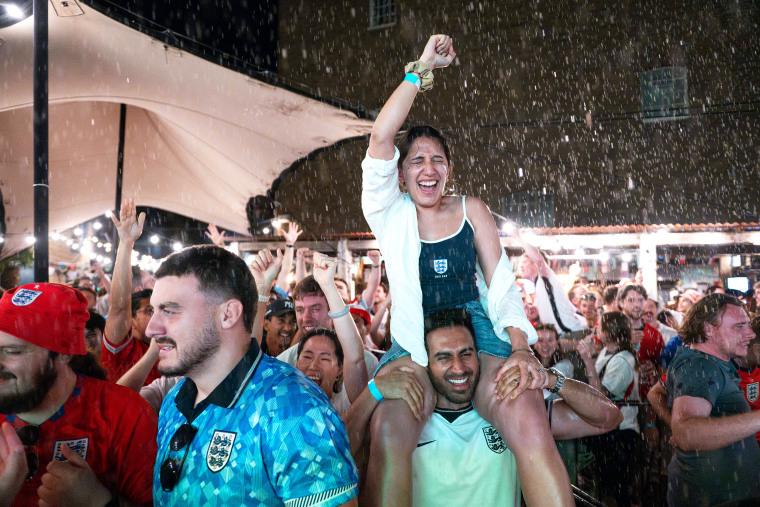
LONDON — Scotland fans famously drank Boston dry.
But while the team’s exploits on the field could not match the success of its supporters, pubs in England — some of which are struggling financially — have been boosted by the boon in beer sales from the team’s run to the World Cup semifinals.
England plays archrival Argentina in Atlanta on Wednesday, an 8 p.m. kickoff back home (3 p.m. ET) that will likely see fans flock to pubs across the country hoping to see their team make its first World Cup final in 60 years.
The profit made from the World Cup accounts for around 15% of the annual sales made by the Bread and Cheese pub in Thundersley, a small village around 40 miles east of London, owner Steve Haslam told NBC News in a telephone interview Tuesday.
He said he expected to make around 7,000 pounds to 9,000 pounds ($9,400 to $12,000) more than the average Wednesday, when England kicks off.
And his pub is not alone. Around 5.5 million extra pints had been sold during group stages alone, according to UKHospitality, a trade body that represents the country’s hospitality and leisure sector.
Emma McClarkin, the CEO of the British Beer and Pub Association, said in an email Tuesday that it expected “Wednesday to be the most successful night of the tournament, with more than 6 million extra pints potentially sold,” around a 75% increase on the 8 million pints typically sold on an average Wednesday in July.
However, figures compiled by her organization and published in May show that 161 pubs across Britain closed between January and March, the equivalent of almost two a day.
Overall “margins are getting squeezed because it is a tough time for pubs right now,” said Haslam, the owner of the Bread and Cheese who is also director of Aim Pubs, a family business that owns eight pubs across the United Kingdom.
Having initially refused, the government did eventually relent and relax licensing laws for England’s second-round match against Mexico, allowing pubs to stay open until 5 a.m. local time.
But both UKHospitality and the British Beer and Pub Association say lawmakers need to do more to protect the industry and blame high business rates and taxes as contributing factors to pub closures.
It’s a view shared by Ash Corbett-Collins, chairman of the Campaign for Real Ale or CAMRA.
The “government needs to fully recognize the contributions pubs make to the economy and social well-being of local communities,” he said. “We risk losing more and more pubs unless meaningful support is given.”
Fairer business rates and less tax on food and drink, including beer, would help out, he said. “The industry can’t rely on a sports tournament every four years to survive,” he added.
A spokesperson for Britain’s Treasury said the government was backing the hospitality industry by cutting taxes “on family attractions and kids meals this summer, reforming business rates, extending World Cup opening hours, and taking action on the cost of living to boost the sector.”
The British government also announced in January that pubs and live music venues would be given a 15% discount on their business rates from April and not see increases for two years.
The British Beer and Pub Association said that this was “vital, but temporary” but a longer-term plan was required to “save pubs, jobs, and hearts of communities.”
And Haslam also said that the cut was largely ineffective and that he believed the government should revise the business and other taxes to help out.
“The great British pub is the heart of the country. People go to pubs to make memories. They’re social hubs doing so much good for the community,” he said. “Pubs have changed my life.”
This post appeared first on https://www.nbcnews.com