

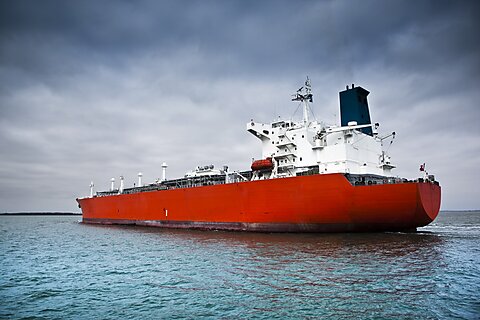

Amid the recent shutdown of a refinery and looming closure of another, California is grappling with how to replace lost in-state fuel production. Logically, one obvious source would be refineries on the US Gulf Coast, home to one of the world’s largest concentrations of refining capacity. Yet according to a recent Bloomberg report, California is instead importing gasoline that first detours through the Bahamas.
The explanation for this curious, circuitous trade is not geography, refinery capability, or fuel specifications, but a century-old protectionist maritime law called the Jones Act.
Under the Jones Act, goods transported between US ports must move on vessels that are US-flagged, US-built, and at least 75 percent US-owned. The result is a dramatic inflation of shipping costs.
US-built product tankers are estimated to cost nearly $170 million more than comparable vessels built in Asia—roughly $220 million versus $50 million—and to have annual operating costs that are more than $8 million higher per ship. Beyond their cost, such vessels are also scarce. Of nearly 7,500 oil tankers worldwide, just 54 comply with the Jones Act. Of those, only 43 are product tankers suited to transporting refined fuels (the remainder are large crude carriers primarily used to move Alaskan oil to the West Coast and Hawaii).
This combination of high structural costs and limited supply translates directly into extreme freight rates. In 2017, the CEO of a company operating Jones Act tankers acknowledged that such vessels cost three to four times as much as their foreign-flagged counterparts. At points last year, Jones Act tanker rates were reportedly an order of magnitude higher than international alternatives.
Through the Jones Act, the United States has created the world’s most expensive domestic shipping market.
These costs help explain why the Bahamas serve as a waypoint in California’s fuel supply chain.
By shipping gasoline components from the Gulf Coast to the Bahamas aboard foreign-flagged tankers, refiners can avoid the Jones Act altogether. Once there, the products shipped from the United States can be blended into a legally “new and different” fuel and transported onward without ever touching a Jones Act–compliant vessel.
Such is the expense of Jones Act shipping that adding thousands of miles and a foreign stop often costs less than shipping fuel directly between two US states.
But the Bahamas is only one workaround. Another is simply to buy gasoline from overseas.
In 2024, major suppliers of refined products to the West Coast included South Korea (approximately 5,300 nautical miles from Los Angeles) and India (roughly 10,000 nautical miles away). By comparison, the voyage from Houston to Los Angeles is on the order of 4,500 nautical miles. Yet despite being geographically closer, the US Gulf Coast is frequently not cost-competitive once shipping costs are factored in.
As a California Energy Commission report pointed out, importing gasoline from Singapore was 60 percent cheaper than from the Gulf Coast—25 cents per gallon versus 10 cents per gallon—owing to the use of Jones Act shipping and Panama Canal fees despite the much greater distance.
California’s fuel buyers, therefore, often look to Asia—or even Europe—rather than to Texas or Louisiana. As the Los Angeles Times observed in 2024, following the refinery closure announcements:
California imports about 1.1 billion gallons of gasoline annually, or 8% of its supply, following other refinery closures or conversions in recent years. With the loss of the Phillips plant, the state will need to import as much as 17% of its supply to make up the deficit.
The potential sources include South Korea, Japan, India and other Asian refineries; Britain and the Netherlands; Saudi Arabia and the United Arab Emirates.
…Gasoline refineries on the U.S. Gulf Coast are an unlikely source: The federal Jones Act requires that only U.S.-flagged ships may transit from one U.S. port to another, an expensive proposition given that the vessels must be manufactured in the United States and manned by U.S. crews.
Importing fuel via the Bahamas—or from even more distant locales—is therefore not a surprise, but a predictable consequence of the Jones Act. And this phenomenon isn’t unique to California.
In addition to serving as a transit stop for West Coast–bound fuel, the Bahamas has long been used as a workaround to supply fuel to the US East Coast. It can also make more economic sense to ship gasoline to New England from Europe than from the Gulf Coast, despite Houston being approximately 1,000 nautical miles closer to Boston than Rotterdam. Such facts help explain why a 2023 working paper estimated that Jones Act shipping restrictions impose roughly $769 million in annual costs on East Coast energy consumers alone.
So what benefits are the Jones Act’s restrictions providing to the US maritime industry in exchange for these costs? Precious little.
No Jones Act–compliant tanker has been built since 2017 (and no oceangoing cargo ship of any kind has been delivered by a US shipyard since 2023). Fewer than 60 Jones Act–compliant tankers exist to serve the energy needs of the world’s largest economy that stretches from Guam to Puerto Rico and depends heavily on coastal fuel movements.
In theory, the Jones Act ensures that goods, including fuel, are transported domestically on US-flagged ships constructed in American shipyards. In practice, as the Bahamas example illustrates, the opposite frequently occurs. Domestic supplies are displaced by less efficiently sourced imports, with no commensurate benefit to the US maritime industry—a pure deadweight loss.
Nor has the Jones Act succeeded in building a robust, self-sustaining, or internationally competitive maritime industry. With the United States accounting for just 0.04 percent of global shipbuilding output, good for 19th place, the law has failed to produce a robust industry. It has also fallen short of national security objectives. The US Transportation Command has estimated that it requires access to 86 product tankers to meet sealift needs. Yet only 43 such ships comply with the Jones Act, and their availability is uncertain: a 2020 government study warned that accessing “significant portions” of this fleet could “disrupt the US economy at an unacceptable level.”
And plainly, the law is not meeting the country’s energy or broader economic needs.
In the end, California’s gasoline detours through the Bahamas are not an oddity or a temporary market quirk. They are a revealing stress test of the Jones Act itself. When a law designed to promote domestic shipping ends up making it cheaper to source fuel from across oceans than from within the same country, it is difficult to argue that it serves its stated purposes. If policymakers are serious about affordability, resilience, and energy security, the lesson from California is clear: a shipping law that forces American fuel to leave the country to move within it is overdue for fundamental reform, if not outright repeal.