
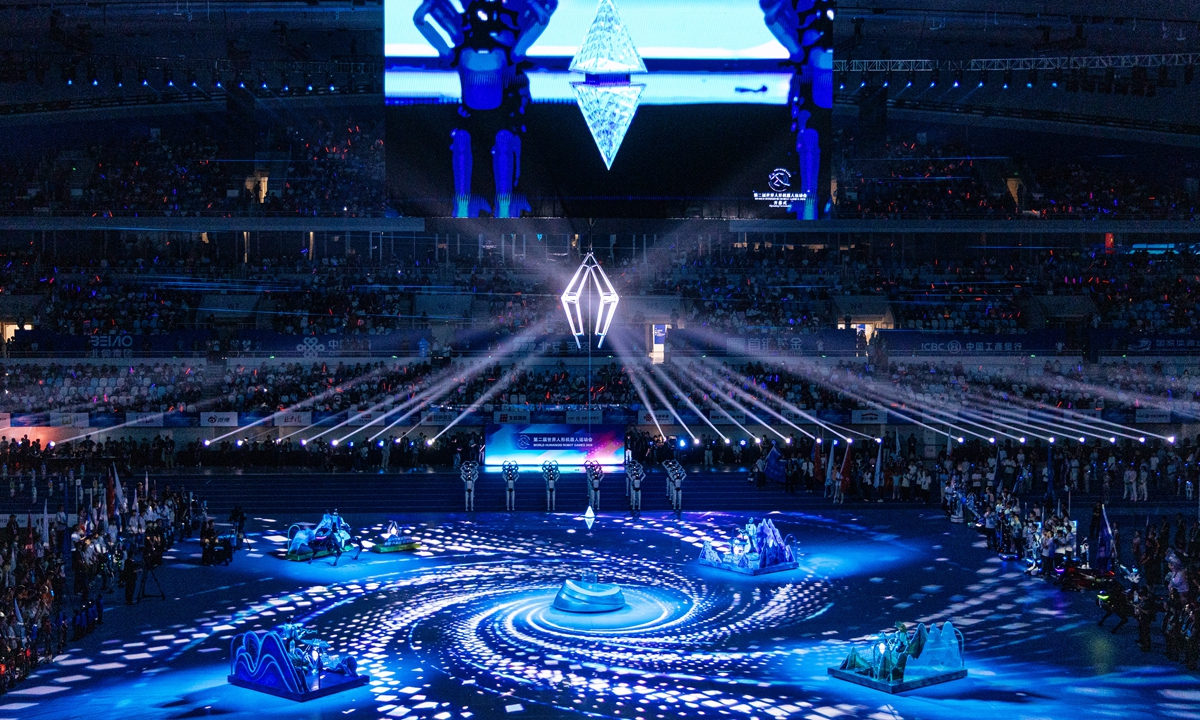
The atmosphere inside the National Speed Skating Oval shifted to dramatic silence as a humanoid robot mounted on a mechanical horse took center stage. With precision movement, the machine drew back a bow and released an arrow that struck its target perfectly, igniting the Zhixin, or intelligence chip. This glowing centerpiece serves as the symbolic equivalent of an Olympic flame for the second World Humanoid Robot Games, which officially kicked off in Beijing this past Saturday. The event follows closely on the heels of the 2026 World Robot Conference, marking a massive week for robotics showcases in China’s capital.
The opening ceremony immediately pushed the boundaries of athletic performance, leaving spectators stunned by the capabilities of modern machinery. The Tien Kung Ultra humanoid robot, developed by Beijing-based X-Humanoid, stole the spotlight during early demonstrations by clocking a 100-meter sprint in just 9.39 seconds, effectively beating Usain Bolt’s legendary world record. That same model soared to a height of 288.43 centimeters in the standing high jump. These feats were accompanied by collaborative displays where elite human athletes competed side-by-side with robots in table tennis, football, and tennis, blending biological skill with algorithmic efficiency.
Beyond individual records, the sheer scale of this year’s games represents a quantum leap over the inaugural edition. Organizers reported that participation has surged, with over two thousand robots from sixteen different countries joining forces across six continents. The competition schedule has expanded significantly to include fifty-one events, introducing spectator favorites like martial arts and dance to keep crowds engaged. To ensure these machines can perform safely and effectively, specialized infrastructure was required; Taishan Sports had to redesign traditional running tracks and artificial turf using custom formulas to handle the extreme weight and static electricity generated by metal frames rather than human flesh and bone.
Perhaps most significant is the shift toward true independence for these machines. For this second iteration of the games, officials have implemented much stricter autonomy requirements. While some obstacle races still allow guidance, nearly all other competitions require robots to operate entirely on their own without remote control_ Any task completed via human intervention now receives half the scoring weight of those finished autonomously. According to industry analysts, this move reflects a broader global ambition to transition robots from remotely operated tools into independent agents capable of navigating and interacting with the physical world without a human hand at the controls.