
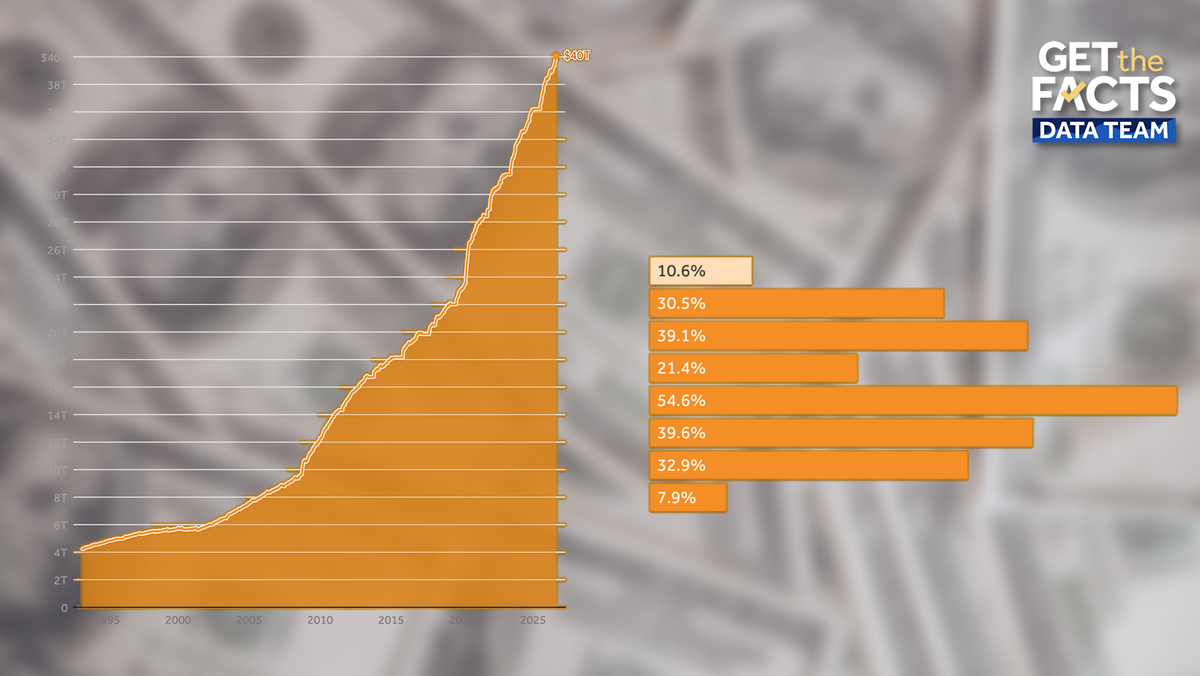
The United States has reached a sobering financial milestone as the national debt officially climbed past the 40 trillion dollar mark, according to latest figures from the Treasury Department. This staggering sum represents a massive shift in the country’s economic landscape over the last few decades. Since the turn of the century, the national debt has surged by nearly 600 percent, climbing from roughly 5.8 trillion dollars in 2000 to its current peak. When broken down across the entire population, each American now carries a theoretical burden of approximately 116,800 dollars.
Tracing this growth reveals a complex history of political leadership and global crises. While various administrations have seen significant increases, different metrics tell different stories. For instance, while Barack Obama saw the highest percentage increase during his first term as he navigated the aftermath of the 2008 financial crisis, Joe Biden’s presidency witnessed the largest raw dollar increase at 8.45 trillion dollars. Donald Trump also oversaw substantial growth, with debt rising by 39.1 percent during his first term alone. Much of this acceleration can be attributed to the unprecedented spending required to combat the COVID-19 pandemic toward the end of Trump’s first term and throughout Biden’s tenure.
At its core, this mounting debt is driven by a persistent gap between what the federal government earns and what it spends. Federal spending spiked by about 50 percent between 2019 and 2021 due to emergency pandemic measures, further widening a deficit that has become almost permanent. In fact, Americans haven’t seen a federal surplus since 2001, meaning the government hasn’t brought in more money than it spent in over two decades.
Visualizing such astronomical numbers remains a challenge for most people because trillions operate on a scale far beyond daily experience. To put it in perspective, analysts often compare these sums to something tangible like median household income to illustrate just how vast a single trillion dollars is—let alone forty of them. As the balance continues to rise, economists and policymakers remain locked in debate over whether this trajectory is sustainable or if drastic changes to federal spending are inevitable.