
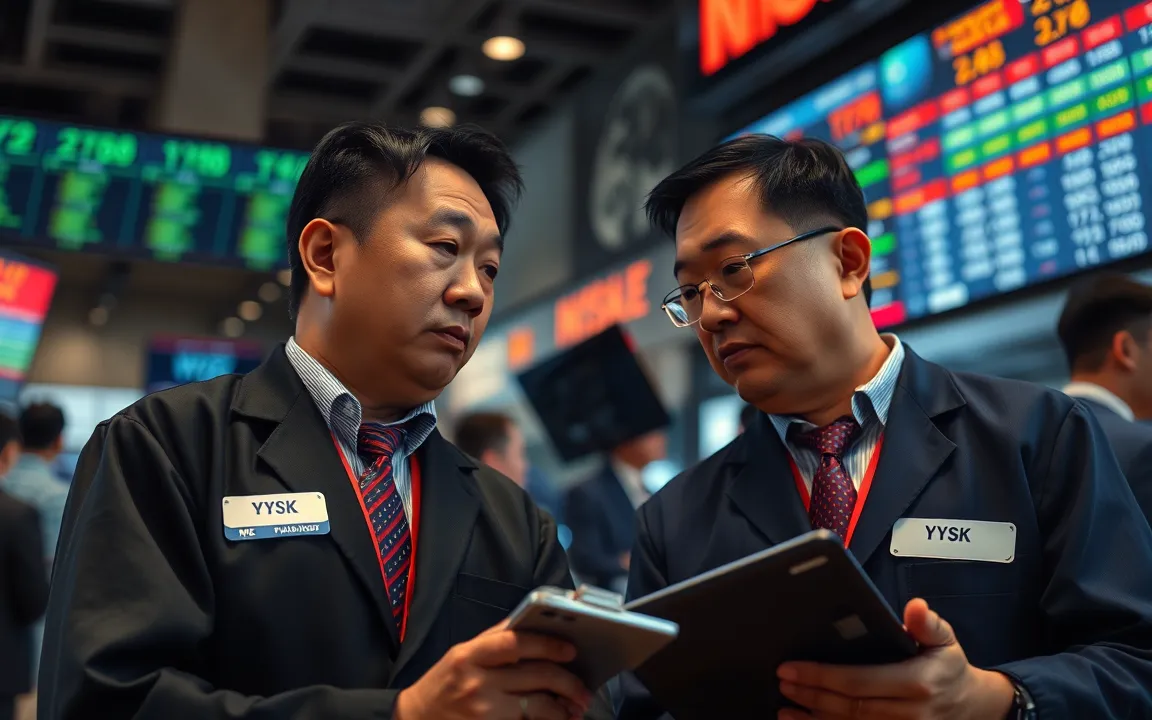
Asian equities were under pressure on Friday, with Japan’s Nikkei 225 and South Korea’s KOSPI at the centre of a volatile session as rising global bond yields and expensive oil renewed concerns over valuations and inflation.
The Nikkei fell about 0.8% in morning trade, extending its loss for the week to roughly 4.4%, while the KOSPI swung around flat after opening 1.35% lower.
The moves came after US Treasury yields resumed their climb, erasing much of the relief triggered by Washington’s decision to expand long-bond buybacks. Brent crude remained above $93 a barrel.
Nikkei faces a fresh domestic rate test
Japan’s market has an extra complication, as inflation is strengthening just weeks before the Bank of Japan’s next policy meeting.
Core consumer prices rose 1.8% in July from a year earlier, accelerating from 1.6% in June. Inflation excluding both fresh food and fuel also quickened to 1.9%, adding to evidence that underlying price pressure is rebuilding.
The BOJ is already running its policy rate at 1%, a 31-year high, and meets again on September 17-18. Markets are leaning towards another quarter-point increase.
That leaves the Nikkei vulnerable to a combination of higher Japanese rates, elevated US yields and a yen trading near 159 per dollar.
For rate-sensitive technology shares, that is a difficult mix.
Higher discount rates reduce the present value of future earnings, particularly for companies priced on aggressive AI and semiconductor growth assumptions.
KOSPI gives back part of its chip-fuelled surge
South Korea started Friday on the defensive after the KOSPI’s extraordinary 5.89% rebound a day earlier.
The index had surged to 6,852.58 on Thursday as SK Hynix’s 40 trillion won share-buyback and cancellation plan revived confidence in shareholder returns.
SK Hynix and Samsung Electronics were central to that rally, with both semiconductor heavyweights rising sharply as foreign investors returned.
Friday’s early retreat showed how quickly that optimism can be challenged when global yields move higher again.
The KOSPI opened down 1.35% before recovering much of the decline. SK Hynix remained comparatively resilient, helping prevent a deeper selloff.
Elsewhere, Taiwan shares edged higher and MSCI’s broad Asia-Pacific index excluding Japan gained about 0.5%, although both remained vulnerable to the global rate shock.
Bond yields and oil keep Asia on edge
The broader pressure still comes from the US bond market. The 10-year Treasury yield climbed towards 4.71% and the 30-year approached 5.25%, reversing much of Wednesday’s fall.
Treasury Secretary Scott Bessent has said buybacks of longer-dated debt could exceed the newly announced $4 billion per operation.
Yet investors remain focused on the structural problem: US debt has crossed $40 trillion and the budget deficit is running above 6% of GDP.
Deutsche Bank strategist Steven Zeng sees a risk that markets keep resisting policy intervention when debt and deficit fundamentals remain unfavourable, limiting how much technical measures can suppress yields.
Oil adds another constraint. Brent touched a one-month high of $94.71 before easing to about $93.12, while WTI traded near $86.18 as the US-Iran standoff kept the Strait of Hormuz risk premium alive.
The post Nikkei 225 slides, KOSPI whipsaws as surging yields put Asia under heavy pressure appeared first on Invezz